
Pregnancy After Loss or Fertility Challenges: What’s Emotionally Common (and Why You’re Not Doing It Wrong!)
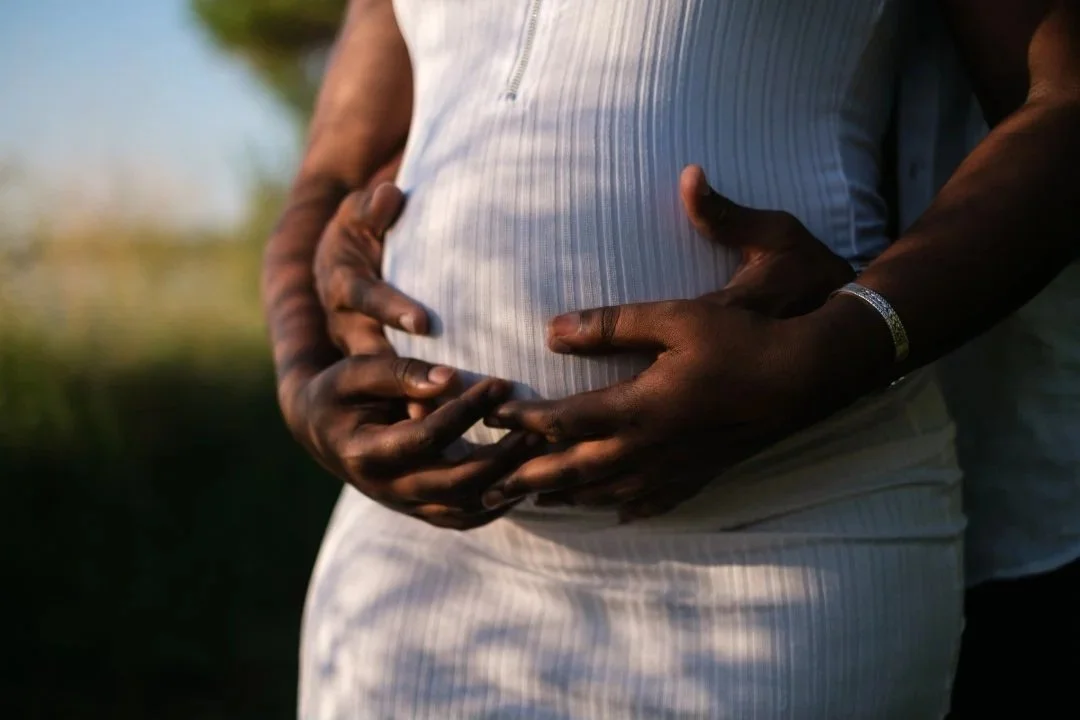
Image of a pregnant woman holding her bump, with her partner behind her also holding her bump.
Pregnancy after loss or fertility challenges is often described as something people should feel grateful for.
But for many, it feels nothing like the picture they were given.
Instead of joy, there may be fear.
Instead of excitement, a sense of waiting.
Instead of ease, a constant awareness of what could go wrong.
If this is your experience, you’re not alone, and you’re not doing pregnancy wrong.
Why Pregnancy After Loss Feels So Different
When you’ve experienced pregnancy loss, infertility, or a long and difficult journey to conceive, your body and mind have learned something important: pregnancy is not guaranteed to be safe.
Even when things are going well medically, that learning doesn’t disappear.
This isn’t pessimism.
It isn’t a lack of gratitude.
It’s a nervous system shaped by experience.
Pregnancy after loss is emotionally complex because it carries both what is happening now and what has happened before.
Fear and Hope Often Exist Side by Side
One of the most confusing aspects of pregnancy after loss is how contradictory your emotions can feel.
You might notice:
Relief at being pregnant, followed immediately by fear
Moments of hope that feel quickly shut down
A sense that enjoying pregnancy might somehow make things worse
Many people describe feeling as though hope itself is risky - as if allowing joy might “tempt fate”.
This internal tug-of-war can be exhausting.
From a psychological perspective, this makes sense. When something has been taken away before, your mind and body may try to protect you from further pain by limiting emotional investment.
This isn’t a failure to hope. It’s an attempt to stay safe.
Heightened Awareness of Your Body
Pregnancy after loss often brings a deep attentiveness to physical sensations.
You may find yourself:
Monitoring every twinge or symptom
Replaying bodily sensations from previous pregnancies
Seeking constant reassurance from your body
This hypervigilance is not overreacting. It’s your nervous system doing what it’s designed to do after threat: scan for danger.
While this can feel distressing, it’s important to understand that it comes from care and protection, not weakness.
Over time, with support, the nervous system can learn that safety is being rebuilt. But this happens gradually, not through force or positive thinking.
Mixed Feelings About Bonding
Another common but rarely spoken about experience is uncertainty around bonding.
Some people feel emotionally connected to their baby early on. Others feel cautious, distant, or emotionally flat, especially after loss or fertility trauma.
This often brings shame:
“What if this means I won’t love my baby?”
In reality, emotional distance during pregnancy is often protective. It can be a way of guarding your heart when you’ve learned how painful loss can be.
Bonding is not a test you pass during pregnancy. Attachment is a relationship that develops over time - sometimes slowly, sometimes later, sometimes alongside fear.
Remember, there is no deadline for love.
Grief Can Reappear During Pregnancy
Pregnancy does not erase previous loss.
In fact, it often brings grief closer to the surface:
Milestones that remind you of what was lost
Scans or appointments that trigger memories
A sense of sadness that appears unexpectedly
This can feel confusing, especially when others expect pregnancy to be a “happy ending”.
Grief and hope are not opposites. They can (and often do) exist together.
Feeling grief during pregnancy does not mean you are ungrateful for this pregnancy. It means you are carrying more than one truth at the same time.
Difficulty Trusting the Process
After loss or fertility challenges, trust often becomes fragile.
You may struggle to trust:
Your body
The pregnancy
Reassuring information
Even moments of calm
This can lead to a sense of “holding your breath” throughout pregnancy - waiting for certainty that never quite arrives.
Trust, after loss, is not rebuilt through reassurance alone. It grows slowly through felt safety, consistency, and compassionate support.
“Am I Doing Pregnancy Wrong?”
This is one of the most painful questions many people carry quietly.
When pregnancy doesn’t feel joyful, calm, or exciting, it’s easy to assume something is wrong with you.
But the emotional experiences described above are common responses to loss and trauma, not signs of failure.
They reflect:
Care
Meaning
Love
A nervous system shaped by real experiences
There is no correct emotional way to be pregnant.
How Support Can Help During Pregnancy
Antenatal mental health support after loss is not about forcing positivity or eliminating fear.
It’s about:
Helping your nervous system feel safer
Reducing the struggle with anxious thoughts
Making space for both grief and hope
Supporting you to live meaningfully during pregnancy, even with uncertainty
Approaches such as Acceptance and Commitment Therapy (ACT), Compassion Focused Therapy (CFT), and trauma-informed psychological support can be particularly helpful during pregnancy after loss.
Support can be preventative, not just reactive. You don’t need to wait until you’re overwhelmed to deserve care.
There Is Room for Hope…
Hope after loss often looks different.
It may be quieter.
More cautious.
Less about certainty, and more about allowing moments of presence.
Hope does not have to mean believing everything will be fine. Sometimes it means allowing yourself to live this pregnancy, one moment at a time, with support.
If pregnancy after loss or fertility challenges feels emotionally complex, you are not alone - and you are not failing.
Fear does not mean you don’t care.
Distance does not mean you won’t love.
Grief does not cancel hope.
Ongoing support and resources
If pregnancy after loss is something you’re navigating, thoughtful support can make a real difference.
At Little Steps Psychology Practice, we can:
Provide evidence-based psychological therapy to support you and your partner through, conception, pregnancy and into parenthood
Provide practical support grounded in ACT, EMDR, and compassion-focused approaches
Provide antenatal mental health education, and gentle, psychologically informed reflections.
You can:
Follow along on Instagram for regular antenatal mental health and parenting content.
Join the mailing list for free resources and reflections on pregnancy, parenthood, and mental wellbeing.